

Modern Unmanned Aerial Vehicles (UAVs) have transitioned from recreational toys to indispensable tools across critical industries, including industrial inspection, emergency response, and precision agriculture. In these high-stakes environments, a drone’s performance is only as strong as its weakest component. While powerful motors and advanced flight controllers often take center stage, the reliability of low-level electromechanical sensors—like micro switches—is equally crucial. A single failure in a position sensor or safety interlock can lead to catastrophic hardware loss or operational downtime.
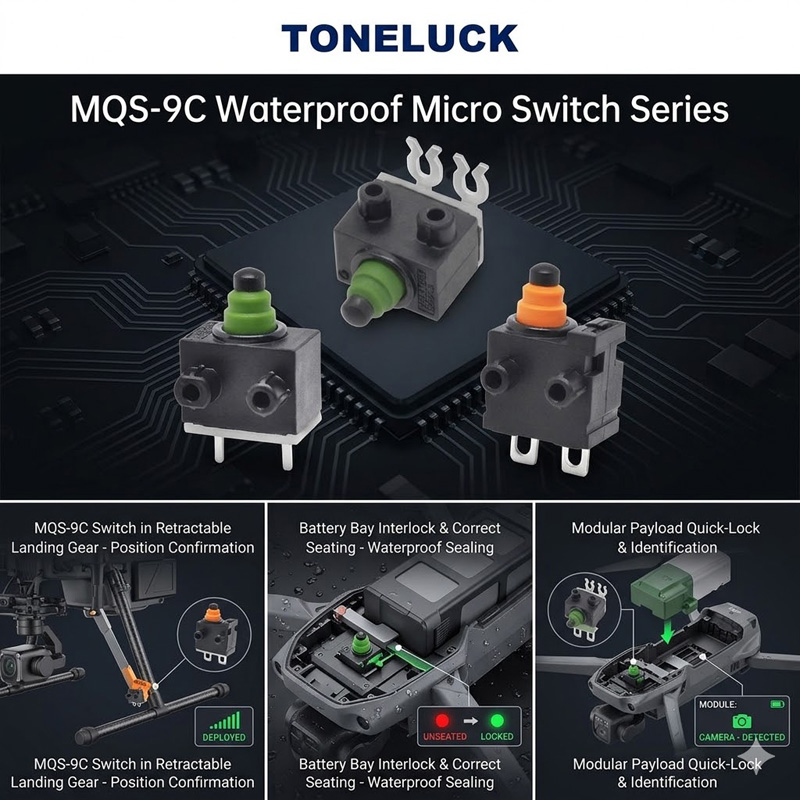
Hardware engineers are increasingly specifying specialized components that can withstand the unique environmental and mechanical stresses of drone flight. The Toneluck MQS-9C series of waterproof micro switches has emerged as a high-reliability solution for these demands, offering a compact, durable, and IP-rated platform for critical drone subsystems.
Understanding the MQS-9C Series: Compact, Sealed, and Versatile
The Toneluck MQS-9C series is a subminiature micro switch designed for harsh environmental conditions. The central engineering feature is the integrated elastomer bellows, typically made of high-grade rubber (seen in green or orange), which hermetically seals the switch plunger. This sealing, combined with robust internal construction, allows the switch to achieve an IP67 rating, making it completely dust-tight and resistant to temporary immersion in water. This is vital for drones that operate in unpredictable weather, such as maritime patrol, search and rescue in rain, or agricultural spraying.
Furthermore, the MQS-9series platform (which includes the MQS-9C sealed variants) is exceptionally versatile. Hardware designers can choose from multiple mounting styles, terminal configurations (PCB pins, quick-connect tabs, or U-shaped terminals), and actuator types (plungers or simulated roller levers). The variants with different coloured bellows often signify specific internal contact materials or operating force specifications tailored to different sensing applications. This breadth of options allows for seamless integration into diverse mechanical designs without unneeded complexity.
Core Drone Applications: Precision Position and Safety
In sophisticated drone designs, the MQS-9C series excels in applications where precise position confirmation and environmental robustness are paramount. These are not merely ‘buttons’ but are integrated as sensors that provide a binary confirmation of mechanical state to the flight controller.
1. Landing Gear Deployment and Position Confirmation
A primary application for high-end commercial drones is retractable landing gear. Drones designed for long-range inspection or high-quality cinematography often feature landing legs that fold away to provide an unobstructed 360-degree camera view. However, confirming that the gear is completely extended and locked before touchdown is critical. Failure to do so can lead to a crash upon landing.
The MQS-9C, particularly variants with a durable roller lever, is integrated at the maximum extension point of the landing gear mechanism. The robust internal snap-action mechanism and the sealed design are crucial here, as landing gear components are directly exposed to the dust and impact from takeoffs and landings. The switch’s precise operating point ensures that the signal ‘GEAR EXTENDED’ is only generated when the legs are structurally secure. The integrated O-ring and bellows ensure this confirmation signal is reliable cycle after cycle, even in maritime or desert environments.
2. Critical Battery Bay Interlock and Seat Confirmation
As drones become more intelligent, the integration between the airframe and its high-power smart batteries is deeper. Ensuring that high-voltage battery packs are correctly seated and mechanically locked is essential for safe operation and optimal power delivery. If a battery is only partially inserted, severe electrical arcing can occur during high-G maneuvers or structural flexing, potentially causing a mid-air power loss.
An MQS-9C switch (often the pin plunger or simulated roller variant, with a clean right-angle or straight PCB pin layout for integration onto the main power distribution board) can be utilized as a safety interlock. The switch is positioned to be depressed only when the battery locking latch is fully engaged. The flight controller can monitor this switch’s state, preventing the motors from arming or providing a specific ‘BATTERY LOCK ERROR’ warning on the ground station software if the switch is unactuated. The sealed nature of the MQS-9C is vital here to protect the low-voltage logic signal from the chemical residues and moisture often present in drone battery bays.
3. Modular Payload Detection and Quick-Lock Mechanisms
Industrial drones are increasingly designed to be modular, allowing operators to quickly swap between camera systems, thermal sensors, LiDAR units, and agricultural spraying tanks. These interchangeable modules require reliable and environmentally robust mechanisms for quick-locking and identification.
The MQS-9C series, with its diverse terminal options (including U-shaped or tab terminals for quick-wiring or chassis mounting), can be integrated into the payload bay interface. Multiple switches can be arranged to physically detect when a module is locked into place. In more complex designs, the combination of actuated and unactuated switches can form a simple binary code to allow the drone to automatically identify the type of payload attached and load the corresponding software profile. The environmental sealing ensures that swaps done on a dusty field or in humid weather do not lead to false readings or module communication errors.
Engineering Advantages for Aerospace Integration
For drone engineers, the MQS-9C provides key advantages that are critical for aerospace component selection.
Minimal Weight and Compact Footprint
Drone designs are inherently limited by weight and space. The subminiature form factor of the MQS-9C allows it to be integrated into vertical structural ribs, compact gimbal assemblies, and tight battery sockets without adding noticeable mass. Multiple switches can be integrated into a single subsystem with minimal spatial penalty.
Superior Vibrational and Shock Resistance
Multi-rotor drones operate under intense high-frequency vibrations generated by brushless motors spinning at thousands of RPMs. Standard low-end switches can suffer from contact chatter under these conditions, leading to false sensor signals that can confuse flight controllers. The MQS-9C is engineered with premium internal snap-action mechanisms and contact materials that provide high contact force and stable electrical characteristics, ensuring clean signal transitions even under extreme mechanical vibration and G-forces.
IP67 Sealing: Protecting Critical Control Signals
As drone operations push into agricultural spraying, maritime search, and infrastructure inspection in all weather, component sealing is no longer optional. The MQS-9C’s IP67 rating ensures that critical low-voltage logic signals for safety interlocks are never compromised by dust ingression or moisture, providing consistent performance throughout the entire operational life of the aircraft.
Conclusión
The future of the industrial drone market is dependent on increased autonomy and predictable reliability. As drone designs grow in complexity, the importance of robust electromechanical sensors cannot be overstated. The Toneluck MQS-9C series waterproof micro switch provides a compelling engineering platform, offering the precise position confirmation, high environmental sealing, and vibrational stability needed to keep modern drones flying safely and reliably. From protecting expensive camera payloads to ensuring perfect landing gear deployment, this compact switch delivers industrial-grade performance where it is needed most.