

The global drone industry has expanded far beyond recreational quadcopters. Today, unmanned aerial vehicles (UAVs) are deployed in critical operations such as agricultural thermal spraying, high-altitude mapping, search and rescue, and industrial inspections. In these high-stakes environments, drone reliability depends heavily on the performance of its internal electronic components.
Among these hardware systems, the subminiature micro switch plays a vital role as a tactile sensor, mechanical interlock, and safety limiter. The Toneluck MQS-9B Small Micro Switch has emerged as a preferred solution for aerospace and hardware engineers seeking maximum reliability within highly confined spatial footprints.
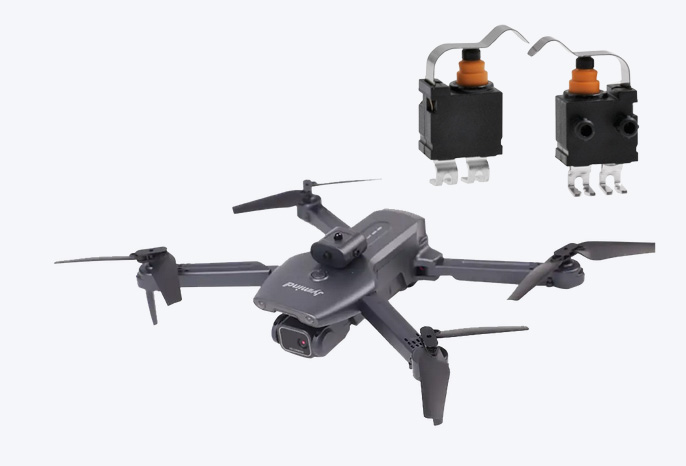
Technical Specifications Overview
Before analyzing its practical applications, it is essential to understand the structural layout and electrical characteristics of the Toneluck MQS-9B.
| Feature / Metric | Technical Characteristic |
| Model Platform | Toneluck MQS-9 Series (Subminiature Snap-Action) |
| Contact Configurations | SPDT (Single Pole Double Throw), SPST-NO, SPST-NC |
| Terminal Configurations | Straight PCB, Right-Angle PCB, Left-Angle PCB, Solder Terminals |
| Actuator Styles | Pin Plunger, Simulated Roller, Straight Hinge Levers |
| Approvals & Certifications | UL, cUL, ENEC, CQC |
| Environmental Compliance | RoHS compliant, high thermal stability materials |
Critical Applications of the MQS-9B inside UAV Systems
Weight minimization and vibrational resilience are two primary design constraints when engineering drone subsystems. The MQS-9B addresses both requirements, making it an excellent fit for several vital aircraft subsystems:
1. Landing Gear Deployment and Locking Sensors
For advanced commercial drones featuring retractable landing gear, confirming that the mechanical legs are completely deployed and securely locked before touchdown is critical to preventing fuselage damage.
-
The Solution: An MQS-9B micro switch equipped with a simulated roller or hinge lever is positioned at the extreme mechanical limits of the landing gear assembly. When the gear reaches its fully extended state, it physically depresses the switch plunger, transmitting an instantaneous digital signal to the flight controller (FC) to confirm a safe landing configuration.
2. Payloads, Gimbals, and Battery Interlocks
Industrial drones carry sensitive payloads, including thermal cameras, LiDAR sensors, and agricultural payload tanks.
-
Bay Lock Verification: The MQS-9B serves as a physical interlock sensor within quick-release payload bays. If a camera or chemical tank is not fully engaged and clicked into its structural housing, the switch remains unactuated. The drone’s onboard firmware can then prevent motor arming, protecting expensive equipment from dropping mid-flight.
-
Smart Battery Seating: High-capacity LiPo/Li-ion drone batteries must be firmly secured. Integrating an MQS-9B switch into the battery retention mechanism ensures the primary power rails cannot arc or disconnect due to high-G maneuvers or structural flexing.
3. Motor Arming Safety Switches and Physical Limiters
In specialized autonomous drones or custom-built unmanned platforms, manual physical switches are frequently utilized as hard-wired emergency isolators or mechanical safety overrides. Due to its snap-action engineering, the MQS-9B ensures clean, bounce-free contact transition, providing reliable signal transmission to the flight management software without electrical noise interference.
Key Advantages of the MQS-9B for Aerospace Engineering
Compact and Ultra-Lightweight Form Factor
Every gram saved on a drone’s empty weight directly translates to increased flight time and payload capacity. The MQS-9B features an exceptionally small subminiature housing, allowing hardware designers to place multiple sensing units directly onto compact internal power distribution boards (PDBs) or inside tight mechanical joints without adding unneeded weight.
Superior Vibrational and Shock Resistance
Drones experience severe high-frequency vibrations generated by multi-rotor brushless motors operating at thousands of RPMs. Standard low-end switches can suffer from contact chatter under these conditions, causing false sensor readouts. The Toneluck MQS-9B utilizes a premium internal spring mechanism that maintains high contact force, guaranteeing electrical stability even during harsh aerial maneuvers or turbulent weather conditions.
Versatile PCB and Terminal Mounting Layouts
Drone architectures vary drastically between manufacturers. To accommodate different layout restrictions, the MQS-9B offers a wide array of mounting orientations, including right-angle, left-angle, and straight PCB pin options. This flexibility allows engineers to seamlessly integrate the switch into vertical structural ribs or flat surface-mount circuit boards.
결론
As unmanned aerial vehicles continue to take on more complex industrial and civil operations, the margin for hardware failure drops to zero. The Toneluck MQS-9B small micro switch provides the exact combination of lightweight design, high tactile responsiveness, and structural durability required to keep modern drone flights stable, predictable, and safe.